Cellular IoT

Why cellular IoT

Selecting the right LPWAN requires looking beyond datasheets to real-world performance.
Here is why Cellular IoT (LTE-M/NB-IoT) is the superior choice over alternatives like LoRaWAN, Sigfox, or Wi-SUN.

Are you planing a project with Cellular, NTN or DECT NR+[Fill in form here]

Complete cellular IoT solution

Enhance your product with low power cellular connectivity: we have everything you need!

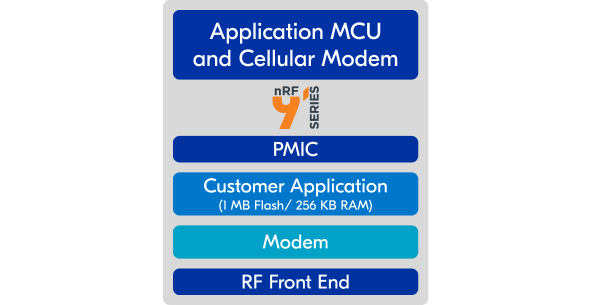
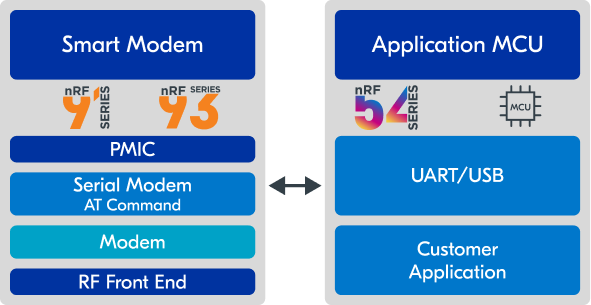
Cellular loT design has typically been a fragmented experience, with multiple components coming from different vendors such as host MCU, RF front end, cellular module, GNSS module, secure element, MIC and other elements. This fragmented solution ownership brings various challenges and risks to product developers, often leading to a sub-optimal implementation that requires many tradeoffs around cost, performance and power consumption.

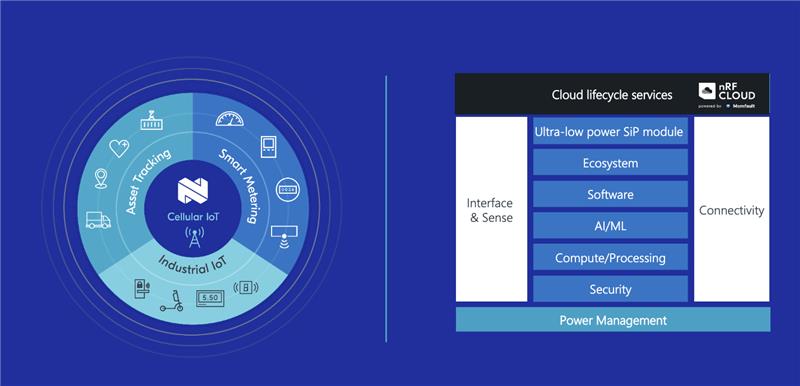
At Nordic our goal is to streamline cellular product development and support the entire product lifecycle. This is why we have integrated all the different parts of our cellular offering into a complete solution – a fully Nordic-owned and controlled offering that includes hardware, software, tools, cloud services and our world-class support. 
graphical user interface, application

Watch our webinar to learn how Nordic's integrated cellular solutions can take you to market faster.


nRF91 Series key benefits

The advantages of the nRF91 Series in cellular IoT

icon  Integration: We have enabled an unprecedented level of integration by making a complete communication and application module with all relevant components in a tiny 10x16mm System-in-Package (SiP) for nRF9160 SiP , 11x12mm for the nRF9151 SiPand 7x11mm for the nRF9131 mini SiP. This allows for cost efficient and compact designs that are not possible with competing solutions, such as a solar-powered animal tracker weighing an impressive 2.5 grams.
 icon Low Power: Your product's power consumption is not determined by a few datasheet data points, but by the average power consumption during operation. The nRF91 Series was built from the ground up for unparalleled power efficiency for all network conditions, making it possible to create ground breaking products like the world’s first solar-powered and batteryless cellular IoT asset trackerthat can operate perpetually on harvested solar energy.
 icon Ease of use: Development is streamlined with great documentation, full software development kit support, flexible hardware and powerful development tools. This allows customers to save significant time and resources in their development cycle while achieving the desired performance and energy targets of their applications.
 icon Global certifications: Certified for operations in all key regions and with all major operators, allowing your product to be easily deployed in a global stage without a complex BOM and supply chain for region specific components.

Power consumption beyond the datasheet

Nordic takes a holistic approach

Optimized for total average current consumption: beyond PSM floor currents

When evaluating cellular solutions, it is vital not to rely solely on a few specification points as there are various factors affecting power consumption. In the case of Power Saving Mode (PSM) floor currents, drawing conclusions based on this metric alone can lead to erroneous assessments of a device's power efficiency. Low PSM floor currents often have hidden caveats such as lack of RAM retention, and sometimes even GPIO retention. This translates into significant power consumption overhead on cellular operations, resulting in a higher average current consumption of your device. In addition, traditional cellular devices require a host MCU which increases the overall system power consumption. Nordic makes it easy to estimate and measure power consumption with our developer-friendly tools.

Looking at a data exchange example with various PSM intervals, we see that even though Module X has 50% lower PSM floor current, the average current consumption can be 7 times lower on nRF9160, even for long PSM intervals. This is because the wake up energy on Module X is much higher than on nRF9160, and that has a larger footprint than PSM floor in the overall energy consumption. 

line chart 

*Calculations with comparable external MCU for Module X with sleep current at 14µA (with RAM retention).

What this translates to in your end product is reduced battery size and cost, allowing for much more cost-effective and compact designs that are simply not possible with any other cellular device in the market today. The Devzone blog Maximizing battery lifetime in cellular IoT: An analysis of eDRX, PSM, and AS-RAI dives deeper into battery maximization of Cellular IoT applications.

Whitepapers

shape

Mastering Low-Power Cellular IoT for Multi-Year Battery Life

 
Achieving multi-year battery life in cellular IoT isn't magic, it's clever engineering. This whitepaper will

guide you through every critical decision, from hardware architecture and LTE-M/NB-IoT selection to protocol optimization and cloud strategy. Learn the secrets of ultra-low-power design and build devices that last.


shape

Optimizing GNSS Performance on the nRF91 for Asset Tracking Applications

 
Reliable GNSS performance isn't guaranteed; it's engineered. This whitepaper guides you through optimizing the nRF91 Series, from antenna layout and LTE coexistence to intelligent fallback strategies. Learn how to balance precision and power to build asset trackers that perform reliably, even in challenging urban environments.


shape

Navigating SIM Technologies for Low Power Cellular IoT

 
Choosing the right SIM technology is a strategic decision that impacts your device’s battery life, longevity, and Total Cost of Ownership (TCO). This whitepaper guides you through the pros and cons of traditional plastic SIMs, eSIMs, iSIMs, SoftSIMs and nuSIM. It also demystifies the new GSMA SGP.32 standard for remote provisioning and addresses critical challenges, such as the impact of roaming on Power Saving Mode (PSM) and eDRX. 


shape

Getting Started with NTN Emulation: Integrating the nRF9151 with the Amarisoft Callbox

 
Testing satellite connectivity doesn't have to mean waiting for a satellite to pass overhead. This whitepaper provides a step-by-step guide to setting up a complete NTN emulation environment in your lab using the nRF9151 SMA DK and the Amarisoft Callbox. We cover everything from hardware configuration and eNodeB setup to the specific AT commands required to establish a stable, bidirectional data link over simulated satellite networks.


shape

DECT NR+


Imagine massive, self-healing mesh networks that can run for years on a single battery. It's now possible with DECT NR+. Our new firmware for the nRF91 Series unlocks ultra-low power modes, reducing idle consumption. Learn how to design battery-powered systems, understand latency trade-offs, and see the performance data.


shape

Demystifying Cellular Behavior with nRF91 Modem Tracing using Wireshark

 
Stop guessing why your cellular device isn't performing as expected. This whitepaper is your guide to mastering nRF91 modem tracing, giving you a deep view into the modem's behavior using the industry-standard tool Wireshark. Learn to troubleshoot network issues, validate power-saving features like PSM and eDRX, and analyze everything from AT commands to IP packets; all without needing any special hardware.


shape

Host MCU Communication with the nRF91 Series guide


Choosing between SPI, I²C, and UART for your host MCU is a critical design choice that impacts power, pin count, and complexity. This whitepaper provides a comprehensive guide to help you navigate the trade-offs, evaluating each interface on bit-rate, reliability, and energy consumption. Find the optimal solution for your architecture, whether you're using the nRF91 as a simple modem or a full IP gateway.


shape

Location Technologies for Low-Power Asset Tracking


Achieving both high-precision location and multi-year battery life is the core challenge in asset tracking. This whitepaper details how the nRF9151 SiP and nRF Cloud Location Services provide a flexible platform, combining A-GNSS, P-GNSS, cellular, and Wi-Fi positioning to help you strike the perfect balance between accuracy and power for any use case.


shape

Ultra low power PPP connection using nRF9151


A standard PPP connection can drain hundreds of microamps at idle, negating the power savings of Power Saving Mode. This whitepaper explains how to leverage the CMUX power-saving protocol with the nRF9151 to improve idle consumption to just 2 µA, extending battery life from months to years without ever dropping your IP connection.


Learn from our experts

shape

Look out for upcoming live webinars or find all recordings of our previous sessions available on-demand

Discover our vast library of available on-demand webinars covering all relevant topics within Cellular IoT.